


Quick Summary: Budget 2026-27 for HR & Payroll Teams
The Union Budget 2026-27, presented on February 1, 2026, targets ~7% GDP growth with total expenditure of ₹53.5 lakh crore and a fiscal deficit of 4.3% of GDP. For HR and payroll professionals, the most impactful changes are:
- Buyback gains reclassified as capital gains — impacts ESOP holders
- TCS rates reduced on international remittances, especially education
- ₹10,000 crore SME Growth Fund — hiring surge incoming for MSMEs
- 6-month Foreign Asset Disclosure scheme for NRIs and young professionals
- 200 legacy industrial clusters to be revived — manufacturing workforce expansion
- Biopharma SHAKTI (₹10,000 crore) + Semiconductor Mission 2.0 — new talent demand waves
Imagine redesigning every salary slip overnight, rewriting contracts, and rethinking compliance frameworks. that’s the reality HR leaders face with the Union Budget 2026–27.
This year’s budget is not just about fiscal numbers; it’s about workforce expansion, compliance clarity, and preparing HR systems for scale.
What Is Union Budget 2026-27?
Finance Minister Nirmala Sitharaman presented the Union Budget 2026-27 on February 1, 2026, outlining India's economic roadmap for the year ahead. The budget is anchored on a target of ~7% GDP growth, fiscal discipline, and continued investment in infrastructure, manufacturing, and technology.
For HR and payroll professionals, the budget carries a clear message: India's workforce expansion is set to accelerate, particularly in manufacturing, MSME, biopharma, and semiconductors, and your payroll systems, compliance processes, and hiring strategies must evolve alongside it.
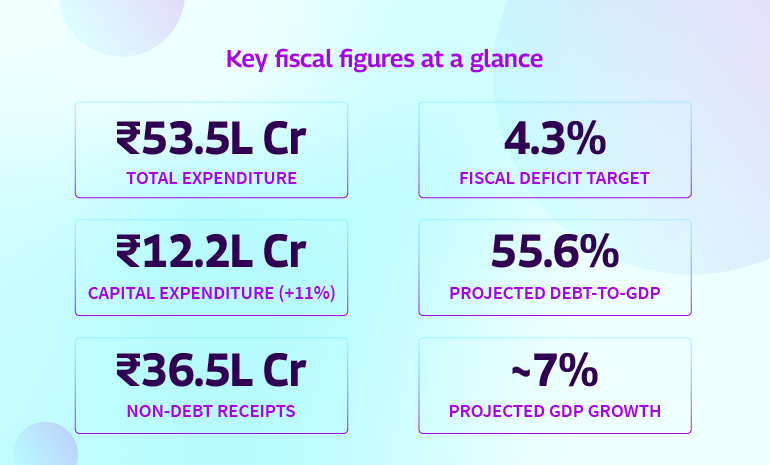
Fiscal Framework at a Glance
The Union Budget 2026-27 is built on fiscal consolidation without sacrificing growth. Here's how the numbers break down:
| Indicator | Value | Change / Note |
|---|---|---|
| Total Expenditure | ₹53.5 lakh crore | — |
| Capital Expenditure | ₹12.2 lakh crore | ↑ 11% YoY |
| Non-Debt Receipts | ₹36.5 lakh crore | — |
| Fiscal Deficit (% of GDP) | 4.3% | Down from prior year target |
| Debt-to-GDP Ratio | 55.6% (projected) | Declining trajectory |
| GDP Growth Target | ~7% | Sustained growth target |
Why this matters for HR: Higher capital expenditure means real infrastructure projects, new semiconductor fabs, biopharma units, and industrial clusters — all of which translate into fresh hiring waves in manufacturing and allied sectors.
Key Tax Changes That Directly Affect Payroll & HR
Budget 2026-27 introduces several targeted tax changes. Here is what each means in practical terms for payroll processing and employee taxation.
1. Buyback Tax Reclassified as Capital Gains (Not Dividends)
Previously, gains from company share buybacks were taxed in the hands of the company. Budget 2026-27 now treats buyback gains as capital gains in the hands of shareholders, not dividends. This has direct implications for employees participating in ESOPs or buyback-linked compensation schemes.
HR Action Required: Review ESOP and stock buyback communications to employees. Ensure your payroll or finance team updates Form 16 and tax advisory accordingly. Employees need clarity on whether their equity exits will be taxed as short-term or long-term capital gains.
2. TCS Changes on International Remittances
Tax Collected at Source (TCS) rates for international remittances — particularly for education-related payments — have been reduced under Budget 2026-27. This directly benefits employees who are studying abroad or sending money for children's overseas education.
Payroll Note: If your company offers education loan or overseas education benefits, update your CTC structuring advice for employees. TCS relief means better take-home and less tax lock-in on remittances.
3. Simplified Dispute Settlement for Tax Cases
A new, relaxed penalty structure for settling tax disputes has been introduced. The government aims to resolve the massive backlog of pending appeals — over 5.4 lakh appeals were pending as of early 2026.
For companies with legacy payroll tax disputes — particularly on perquisites, reimbursements, or deferred compensation — this one-time settlement window is a valuable opportunity to clean up the books before the new financial year.
4. Foreign Asset Disclosure Scheme
A new 6-month scheme allows young professionals and NRIs to disclose foreign assets. This is particularly relevant for senior employees in tech, BFSI, and multinational companies who hold offshore assets, stock options in foreign entities, or investment accounts abroad.
HR Action Required: Communicate this window to senior leadership and NRI employees. Coordinate with your legal or tax advisor to help eligible employees comply within the 6-month window.
TABLE: TAX REFORMS IN BUDGET 2026-27 AND HR/PAYROLL IMPACT
| Tax Change | What Changed | HR / Payroll Impact | Tag |
|---|---|---|---|
| Buyback Tax | Capital gains (not dividend) in shareholder's hands | Update ESOP tax advisory & Form 16 guidance | HR Compliance |
| TCS on Education Remittances | Reduced TCS rates for overseas education | Revise CTC structuring for education benefit holders | Tax Update |
| Dispute Settlement | New relaxed penalty structure for tax appeals | Opportunity to settle perquisite or payroll tax disputes | Tax Update |
| Foreign Asset Disclosure | 6-month window for young professionals & NRIs | Brief senior employees and NRIs; support compliance | HR Compliance |
The ₹10,000 Crore MSME Growth Fund: Impact on Hiring & Payroll
One of the most consequential announcements in Budget 2026-27 for HR professionals is the SME Growth Fund — a ₹10,000 crore corpus to provide equity capital to potential MSME champions. This is not just an economic stimulus; it's a hiring stimulus.
Why MSMEs Are India's Largest Employer
India's MSME sector employs over 11 crore people — roughly 40% of the total workforce — and contributes ~30% to GDP. A ₹10,000 crore equity infusion into high-potential MSMEs will:
- Enable faster scale-up and entry into new markets
- Drive significant hiring in Tier 2 and Tier 3 cities
- Increase payroll complexity: multi-location compliance, contractor vs. full-time structures, PF/ESI enrollment at scale
- Create demand for structured HR systems where none previously existed
Industrial Revival: 200 Legacy Clusters
A new scheme to revive 200 legacy industrial clusters will reignite hiring in traditional manufacturing towns. These clusters — spanning textiles, leather, chemicals, and engineering goods — are significant employers in states like Gujarat, Maharashtra, Uttar Pradesh, and Tamil Nadu.
greytHR Insight: Growing MSMEs often move from Excel-based payroll to structured HR software for the first time during growth phases. Compliance errors, statutory payment delays, and employee onboarding chaos are the most common pain points. Automated payroll software significantly reduces risk during scale-up.
What MSME Payroll Managers Must Prepare For
- Multi-state payroll: state-specific professional tax, LWF, and Shops & Establishments Act compliance becomes critical
- PF & ESI enrollment at scale: rapid onboarding must be paired with accurate statutory registrations
- Contractor management: clear classification between employees and contractors avoids compliance liability
- Investment subsidy tracking: MSME-linked incentives often come with headcount-linked conditions — payroll records become audit evidence
Sector-Wise Budget 2026 Impact: What HR Teams Need to Know
Biopharma & Life Sciences: SHAKTI Scheme
The Biopharma SHAKTI scheme — a ₹10,000 crore, 5-year initiative — positions India as a global hub for biologics and biosimilars. Three new NIPERs will also be established, creating demand for specialized scientific talent.
HR impact: Expect a surge in demand for clinical research associates, bioprocess engineers, QA/QC specialists, and regulatory affairs managers. Compensation benchmarking and talent acquisition in this segment will become highly competitive. R&D-linked pay structures may see greater complexity.
Semiconductors: Mission 2.0
Semiconductor Mission 2.0 focuses on equipment manufacturing, materials supply, and supply chain resilience. As India builds its semiconductor ecosystem, high-skill talent wars will intensify. Global semiconductor firms are already scouting for VLSI designers, process engineers, and supply chain specialists in India.
HR impact: Compensation benchmarking against global rates, international mobility packages, and relocation support will be critical. Companies must also plan for multi-currency payroll if they bring in expat talent.
Infrastructure: Rare Earth Corridors & CCUS
Rare Earth Corridors in Kerala, Andhra Pradesh, Tamil Nadu, and Odisha, plus ₹20,000 crore for Carbon Capture (CCUS) over five years, will drive significant hiring in mining, geology, environmental engineering, and clean energy.
HR impact: Field workers in remote locations require specialized payroll treatment — travel allowances, hazard pay, site-based accommodation perks, and compliance with location-specific labour laws.
Healthcare: Geriatric Care Expansion
Expansion of geriatric care aligns with India's aging demographic. Hospitals and care homes will see hiring surges for geriatricians, nurses, and support staff — sectors with high HR complexity around shift management, overtime, and statutory compliance.
TABLE: SECTOR-WISE HIRING SURGE EXPECTED POST BUDGET 2026-27
| Sector | Budget Trigger | Key Roles in Demand | HR Complexity |
|---|---|---|---|
| Biopharma | SHAKTI scheme (₹10,000 Cr) | Scientists, CRAs, QA/QC, RA Managers | High |
| Semiconductors | Semiconductor Mission 2.0 | VLSI Engineers, Process Engineers, Supply Chain | Very High |
| Manufacturing (MSME) | SME Growth Fund (₹10,000 Cr) | Operators, Supervisors, Finance Managers | Medium-High |
| Infrastructure | Rare Earth Corridors, CCUS | Geologists, Environmental Engineers | Medium |
| Healthcare | Geriatric Care, 3 New NIPERs | Geriatricians, Nurses, Care Staff | High |
| Agriculture | AI advisory tools, Animal Husbandry | Agri-tech Roles, Field Officers | Low-Medium |
HR & Payroll Compliance Checklist for Budget 2026-27
Complete the following before April 1, 2026 — the start of the new financial year:
- Update Form 16 templates to reflect buyback capital gains treatment — communicate to ESOP holders
- Validate TCS configuration in payroll software for education remittances and overseas payments
- Identify NRI and expat employees eligible for the Foreign Asset Disclosure scheme
- Review pending payroll-related tax disputes for the new relaxed settlement window
- Scale up payroll infrastructure if your company is MSME-registered and growing
- Revise compensation benchmarks in biopharma, semiconductor, and infrastructure sectors
- Ensure payroll software is updated with Budget 2026-27 tax slabs before the April run
- Issue an internal HR bulletin communicating relevant budget changes to all employees
- Review field employee payroll — infrastructure workers need correct allowance structures
- Verify shift-based payroll compliance for healthcare workers (overtime, leave, deductions)
How greytHR Keeps You Budget-Ready, Every Year
Every Union Budget brings a fresh round of tax rule changes, compliance updates, and reporting requirements. At greytHR, our team monitors every Budget announcement and proactively updates the payroll engine, so you don't have to manually recode tax tables or worry about incorrect TDS deductions come April 1.
What greytHR Does After Every Budget
- Automatic tax slab updates: payroll engine updated to reflect the latest income tax rates, TCS thresholds, and surcharge changes — before the new financial year
- Form 16 & statutory reporting: all statutory forms (Form 16, Form 24Q, Form 12BB) aligned with the latest CBDT guidance post-budget
- Compliance alerts: HR managers receive in-app notifications when a budget-linked compliance deadline approaches
- MSME-ready payroll: multi-location, multi-state payroll with built-in PF, ESI, PT, and LWF compliance — ready to scale
- ESOP & equity comp support: track ESOP grants, vesting schedules, and ensure post-Budget 2026 capital gains classification is handled correctly
Did you know? greytHR processes payroll for over 30,000 businesses across India, ranging from startups to large enterprises. When the Budget changes tax rules, all of them benefit from automatic updates — zero manual intervention required.
Don't Let Budget Changes Disrupt Your April Payroll
Reading about compliance is one thing; seeing it handled automatically is another. Whether it’s the new Buyback Tax classification or the revised TCS rates, your payroll software should handle the math, not you.
Experience the "Zero-Touch" Budget Update:
- Auto-configured Tax Regimes: See how the system applies FY 2026-27 rules instantly.
- Risk Detection: Identify salary structure gaps before they become compliance penalties.
- One-Click Form 16: Generate audit-ready tax documents for your entire workforce in minutes.
Book A Demo Now Ensure your first payroll of FY 2026-27 is 100% compliant.
FAQs: Union Budget 2026-27
These are the most commonly asked questions by HR managers, payroll teams, and business owners after this year's budget.
What is Union Budget 2026-27 and when was it presented?
The Union Budget 2026-27 was presented by Finance Minister Nirmala Sitharaman on February 1, 2026. It covers the financial year April 2026 to March 2027, with total expenditure of ₹53.5 lakh crore, a fiscal deficit target of 4.3% of GDP, and a sustained ~7% GDP growth objective.
What are the key HR and payroll changes in Union Budget 2026-27?
Budget 2026-27 introduces: (1) Buyback gains treated as capital gains (not dividends), affecting ESOP holders; (2) Reduced TCS rates on international remittances; (3) New dispute settlement mechanism with relaxed penalties; (4) 6-month Foreign Asset Disclosure scheme for NRIs and young professionals; (5) ₹10,000 crore SME Growth Fund driving MSME hiring at scale.
Did income tax slabs get revised in the 2026 Union Budget?
No. The Finance Minister maintained the status quo for FY 2026-27.
- New Tax Regime (Default): Slabs remain unchanged. Income up to ₹12 Lakh remains effectively tax-free for salaried individuals (after Section 87A rebate and ₹75,000 Standard Deduction).
- Old Tax Regime: No changes to slabs or rates.
- Impact: While slabs didn't change, payroll teams must still ensure their systems capture the correct regime selection for new hires, as the New Regime remains the default setting.
If tax slabs didn't change, why do I need to update my payroll configuration?
While the slabs are stable, the rules around salary components have shifted.
- TCS Rates: The reduction in TCS on foreign remittances (for education/medical) impacts how you structure salary for senior employees with children abroad.
- Buyback Tax: The reclassification of buyback gains as "capital gains" directly impacts employees with ESOPs. Your payroll system needs to reflect this to help employees with accurate tax projections.
How does the SME Growth Fund in Budget 2026-27 affect payroll?
The ₹10,000 crore SME Growth Fund provides equity capital to high-potential MSMEs. As these companies scale and hire more workers, payroll teams face increased complexity: multi-state compliance, rapid PF/ESI enrollment, contractor vs. full-time classification, and headcount-linked compliance evidence for subsidy conditions. MSME payroll teams should upgrade to automated payroll software before this growth wave hits.
What is the TCS change in Budget 2026-27 for international remittances?
Budget 2026-27 reduces TCS rates on international remittances, with a specific benefit for education-related transfers abroad. Previously, higher TCS rates caused cash flow concerns for individuals sending money for overseas education. The revised rate reduces this burden and improves liquidity. Payroll teams should update TCS configurations in their payroll software before April 2026.
How does the buyback tax change affect employees with ESOPs?
Under Budget 2026-27, gains from company share buybacks are now taxed as capital gains in the hands of shareholders. Employees who participate in buyback programs will be taxed based on their holding period — short-term capital gains tax (under 12 months) or long-term (over 12 months). HR teams must update Form 16 guidance and internal equity compensation communications accordingly.
Can we still process tax exemptions for "Meal Vouchers" in FY 2026-27?
Yes, and potentially with higher limits. Draft rules associated with the budget suggest an increase in the exemption limit for meal vouchers (up to ₹200/meal). Payroll Action: Ensure your flexible benefit plan (FBP) module is configurable so you can instantly switch to the new limits once the final notification is gazetted.
What sectors are expected to hire most after Budget 2026-27?
Top hiring sectors based on budget allocations: (1) Biopharma & Life Sciences via SHAKTI scheme (₹10,000 crore), (2) Semiconductors via Mission 2.0, (3) MSMEs via the SME Growth Fund and industrial cluster revival, (4) Infrastructure via ₹12.2 lakh crore CapEx and rare earth corridors, and (5) Healthcare via geriatric care expansion and 3 new NIPERs.
What is the fiscal deficit target in Union Budget 2026-27?
The fiscal deficit target is 4.3% of GDP, with total expenditure of ₹53.5 lakh crore, capital expenditure of ₹12.2 lakh crore (up 11%), and non-debt receipts of ₹36.5 lakh crore. The debt-to-GDP ratio is projected to fall to 55.6%.
Does greytHR update payroll automatically for Budget 2026-27 changes?
Yes. greytHR proactively updates its payroll engine after every Union Budget to reflect revised tax slabs, TCS/TDS rates, and statutory filing requirements. All 25,000+ greytHR businesses benefit from these automatic updates. Users receive in-app notifications about changes and compliance deadlines — no manual tax table updates required.
*DISCLAIMER Updated: 02-03-2026 This article is for informational purposes only. For specific tax or legal advice, consult a qualified professional. Sources: Union Budget 2026-27 official documents (indiabudget.gov.in), PIB press releases (pib.gov.in), greytHR editorial research.*


